Rising energy costs are one of the biggest challenges facing SMEs, manufacturing units, and industrial plants in India. With frequent price fluctuations in coal, diesel, furnace oil, and LPG, businesses are actively looking for cost-effective and stable fuel alternatives.
In recent years, biomass briquettes have emerged as a strong contender—offering not only environmental benefits but also significant cost savings. But are biomass briquettes truly more economical than traditional fuels?
This blog provides a data-driven cost analysis, comparing biomass briquettes with coal, diesel, furnace oil, and LPG—helping Indian businesses make informed fuel decisions.
Why Fuel Cost Matters for Indian Businesses
Fuel expenses typically account for 30–60% of operational costs in energy-intensive industries such as:
- Textiles and dyeing units
- Food processing plants
- Chemical and pharmaceutical factories
- Brick kilns and ceramics
- Paper and packaging units
Any reduction in fuel cost directly improves profit margins, pricing competitiveness, and long-term sustainability.
What Are Biomass Briquettes?
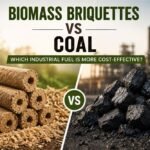
Biomass briquettes are compressed solid fuels made from agricultural and organic waste such as:
- Rice husk and straw
- Wheat straw
- Sugarcane bagasse
- Cotton and mustard stalks
- Sawdust and forestry residue
These materials are processed under high pressure to create a dense, uniform, and high-energy fuel, suitable for industrial boilers and furnaces.
Key Cost Factors When Comparing Industrial Fuels
To evaluate whether biomass briquettes are economical, businesses must consider:
- Fuel price per tonne or litre
- Calorific value (energy output)
- Combustion efficiency
- Equipment and maintenance cost
- Logistics and storage
- Regulatory and compliance costs
Let’s analyze each fuel through this lens.
Current Fuel Price Snapshot in India (2026)
(Average industrial prices; may vary by region)
| Fuel Type | Average Price |
|---|---|
| Biomass Briquettes | ₹5,500 – ₹7,000 / MT |
| Coal (Industrial Grade) | ₹9,000 – ₹12,000 / MT |
| Furnace Oil | ₹45 – ₹60 / litre |
| Diesel | ₹85 – ₹95 / litre |
| LPG (Commercial) | ₹70 – ₹80 / kg |
Calorific Value Comparison
| Fuel | Calorific Value |
|---|---|
| Biomass Briquettes | 3,800 – 4,500 kcal/kg |
| Coal | 4,500 – 6,000 kcal/kg |
| Furnace Oil | ~10,000 kcal/kg |
| Diesel | ~10,800 kcal/kg |
| LPG | ~11,500 kcal/kg |
At first glance, fossil fuels appear superior—but cost per unit of useful energy tells a different story.
Cost per 1,000 kcal: Real Economic Comparison
| Fuel | Approx. Cost per 1,000 kcal |
|---|---|
| Biomass Briquettes | ₹1.3 – ₹1.7 |
| Coal | ₹1.8 – ₹2.2 |
| Furnace Oil | ₹4.5 – ₹6.0 |
| Diesel | ₹6.5 – ₹7.5 |
| LPG | ₹6.0 – ₹7.0 |
Key Insight
Biomass briquettes deliver heat at the lowest cost per 1,000 kcal, even when accounting for slightly lower calorific value.
Fuel Efficiency and Boiler Performance
Biomass Briquettes
- Consistent size and moisture
- Uniform combustion
- Stable heat generation
Coal
- High ash content
- Heat loss due to slagging
- Frequent cleaning required
Liquid Fuels (Diesel, Furnace Oil)
- High efficiency
- Expensive and volatile pricing
In real-world industrial settings, briquettes often achieve 80–90% of coal’s effective heat output at much lower cost.
Maintenance and Hidden Cost Comparison
| Cost Factor | Briquettes | Coal | Furnace Oil/Diesel |
|---|---|---|---|
| Ash Handling | Low | High | Nil |
| Chimney Cleaning | Low | High | Medium |
| Corrosion | Minimal | Medium | High |
| Spare Parts Wear | Low | High | Medium |
| Pollution Control Cost | Low | High | High |
Lower maintenance translates into reduced downtime and lower operating expenses.
Regulatory & Compliance Cost Advantage
With stricter CPCB emission norms, industries using coal and furnace oil often face:
- Pollution control equipment upgrades
- Stack emission penalties
- Production stoppages in non-compliance zones
Biomass briquettes:
- Emit less PM, SO₂, and NOₓ
- Reduce reliance on expensive pollution control systems
- Lower compliance and inspection risk
This indirect cost saving is often overlooked but significant.
Storage, Transportation, and Safety Costs
Biomass Briquettes
- Easy to store
- Non-toxic
- Lower fire risk than liquid fuels
- No spillage loss
Diesel & Furnace Oil
- Requires tanks and pumps
- Leakage and theft risk
- Fire and safety compliance costs
LPG
- Cylinder handling
- Safety audits and insurance costs
Briquettes offer simpler logistics and lower insurance risk.
Real-World Cost Savings for Indian SMEs
Example: Medium Textile Unit (Per Month)
| Fuel Type | Monthly Fuel Cost |
|---|---|
| Furnace Oil | ₹18–20 lakh |
| Coal | ₹12–14 lakh |
| Biomass Briquettes | ₹8–10 lakh |
Savings: 25–40% on fuel expenses
Partial Replacement Strategy
Many factories adopt a hybrid approach:
- 50–70% briquettes
- Remaining coal or oil
This reduces risk, ensures supply stability, and still delivers substantial cost savings.
Industries Where Briquettes Make the Most Sense
- Boilers up to medium pressure
- Thermic fluid heaters
- Steam-based processes
- Continuous heating operations
They are especially beneficial where fuel consumption is high and continuous.
Challenges and Cost Considerations
Supply Chain
- Seasonal biomass availability
- Solved through multi-feedstock sourcing
Initial Trials
- Minor burner adjustments
- Short learning curve for operators
These are one-time or short-term costs compared to long-term savings.
Long-Term Price Stability Advantage
Unlike fossil fuels, biomass briquettes:
- Are locally sourced
- Less affected by global oil or coal markets
- Offer predictable pricing contracts
This stability helps businesses plan budgets more effectively.
Environmental Cost = Business Value
Today’s buyers, investors, and regulators increasingly favor:
- Low-carbon supply chains
- Sustainable manufacturing
- ESG-compliant businesses
Using biomass briquettes enhances brand reputation and tender eligibility, adding indirect financial value.
Final Verdict: Are Biomass Briquettes More Economical?
Yes—for most Indian SMEs and industries.
When evaluated on:
- Cost per unit energy
- Maintenance and compliance costs
- Price stability
- Operational efficiency
Biomass briquettes outperform coal, diesel, furnace oil, and LPG in overall economics.
They are not just a cleaner alternative—but a smarter financial decision for businesses in India.